Showing posts with label research. Show all posts

Jul 15, 2014

Why it's okay to say yes to butter -- without harming your health!

This post is an edited summary of an article by Debbie Bell, a Registered Dietitian, appearing in The State Journal of Frankfort KY, July 22, 2014

For the past 60 years, saturated fat and cholesterol have been wrongfully maligned as the culprits of heart disease, one of the nation’s leading causes of death. 
Dr. Fred Kummerow has spent eight decades studying the science of lipids, cholesterol, and heart disease. His work shows that it’s not saturated fat that causes heart disease, but rather trans fats are to blame. 
Trans fats are created in an industrial process that adds hydrogen to liquid vegetable oils to make them more solid. Another name for trans fats is “partially hydrogenated oils.”
These fats can be found in many foods — but especially in fried foods like French fries and doughnuts, and baked goods including pastries, piecrusts, biscuits, pizza dough, cookies, crackers, stick margarines and shortenings. 
There is some confusion about fats and their impact on LDL cholesterol, often referred to as “bad” cholesterol.  According to the conventional view, high LDL is correlated with heart disease, and saturated fat does tend to raise LDL. However, we now understand that there are TWO kinds of LDL cholesterol particles:
Small, “dense” LDL cholesterol and large, “fluffy” LDL cholesterol
The latter is not “bad” at all. Research has confirmed that large LDL particles do not contribute to heart disease. The small, dense LDL particles, however, do contribute to the build-up of plaque in your arteries, and trans fat increases small, dense LDL. Saturated fat, on the other hand, increases large, fluffy LDL.
In addition, research has shown that eating refined sugar and carbohydrates, such as bread, bagels,and soda, increases small dense LDL particles. Together, trans fats and refined carbohydrates do far more harm than saturated fat ever possibly could.
To read the original article, go to: Saturated Fats, Cholesterol Are Not Evil.
Here's another article to the same effect, and from other sources, from the Wall Street Journal: The Questionable Link Between Saturated Fat and Heart Disease

Nov 4, 2013

Your diet soda may be making you fat.


Studies from multiple sources are discovering that diet soft drinks may not be the healthy choice that most people think they are.

Source of weight gain?

For one study, researchers at the University of Texas Health Science Center at San Antonio followed 474 diet soda drinkers for almost 10 years. They found that diet soda drinkers’ waists grew 70 percent more than non-drinkers. Even more shocking was their discovery that drinking two or more diet sodas a day increased waist sizes 500 percent more as compared to people who avoided the stuff entirely.
A few other reasons why diet pop may not be as good a friend as you think it is.

Greater risk for diabetes:


Drinking one diet soda a day was associated with a 36 percent increased risk of metabolic syndrome and diabetes in a University of Minnesota study. Metabolic syndrome is a condition that includes increased waist size, and puts people at high risk for heart disease, stroke, and diabetes.

And it may not just be making you fatter, but sadder, too...

Possible link with depression:

A study presented at a the American Academy of Neurology meeting found that over the course of 10 years, people who drank more than four cups or cans of soda a day were 30 percent more likely to develop depression than those who steered clear of sugary drinks. The correlation held true for both regular and diet drinks, but researchers noted that the risk appeared to be greater for those who primarily drank diet sodas.


Possible factor in strokes and heart attacks:

Just one diet soft drink a day could boost your risk of having a vascular event such as stroke, heart attack or vascular death, according to researchers from the University of Miami and Columbia University. Their study found that diet soda devotees were 43 percent more likely to have experienced a vascular event than those who drank none. 

But how?

Other studies suggest a clue: "Artificial sweeteners could have the effect of triggering appetite but, unlike regular sugars, they don't deliver something that will squelch the appetite," says Sharon Fowler, obesity researcher at UT Health Science Center at San Diego.

Wikipedia weighs in:

(pun intended!)
The effectiveness of diet soda as a weight loss tool has been called into question. 
Changing the food energy intake from one food will not necessarily change a person's overall food energy intake or cause a person to lose weight. One study at the University of Texas Health Science Center at San Antonio, reported by Sharon Fowler at the ADA annual meeting, actually suggested the opposite, where consumption of diet soda correlated with weight gain. While Fowler did suggest that the undelivered expected calories from diet soda may stimulate the appetite, the correlation does not prove that consumption of diet soda caused the weight gain. The ADA has yet to issue an updated policy concerning diet soda. 
In an independent study by researchers with the Framingham Heart Study in Massachusetts, soda consumption correlated with increased incidence of metabolic syndrome. Of the 9,000 males and females studied, soda drinkers were at 48% higher risk for metabolic syndrome, which involves weight gain and elevated blood sugar. No significant difference in these findings was observed between sugary sodas and diet drinks. The researchers noted that diet soda drinkers were less likely to consume healthy foods, and that drinking diet soda flavored with artificial sweeteners more than likely increases cravings for sugar-flavored sweets.
Learn more...

Sources:

Oct 28, 2013

A connection between gluten sensitivity, and a super-clean home?


Oldways sent a reporter to the International Celiac Disease Symposium, a gathering of 1500 scientists, doctors, and dietitians from more than 30 countries, to get the real scoop on the hubbub surrounding gluten. A few of her findings...
While as many as 8-10% of us may need to avoid gluten, 90% or more of us can enjoy a crusty fresh loaf of wheat bread.
Donald Kasarda, a USDA researcher, surveyed data and found that gluten levels in wheat have stayed pretty much the same for more than 100 years. Kasarda does note, however, that the use of vital wheat gluten as a food additive has increased three-fold in the last 15 years. (Like to read medical study reports? Here ya go.)
And here's the paragraph that contains the news I really love:
Scientists at the conference mentioned several factors that seem to increase our risk for celiac disease: Increased use of antibiotics, which wipe out good bacteria and bad in the gut. The rise in Caesarian deliveries, which bypass the mother’s usual transfer of bacteria to the baby. Introducing gluten into babies’ diets too early or too late (4-7 months seems ideal). The hygiene hypothesis, which theorizes that our immune systems don’t develop properly anymore because our super-clean homes don’t give them enough early exercise.
Hurray! A positive, scientific benefit of not keeping an immaculate house! I'm vindicated at last!  :)

Mar 31, 2013

Better health starts with better facts (great infographs!)

Improving your health starts with improving your knowledge.

To that end, I discovered some cool and helpful infographics, revealing information about how, what and when we eat -- and how that affects our health. Designed by Column Five (under Creative Commons), sponsored by MassiveHealth, makers of the Eatery app for the iPhone.

Here are just a few snapshots from the wealth of data they've unraveled. Note: in all examples, there's more data than I'm showing here. Hit the original site if you're a data geek. Or infograph afficianado.

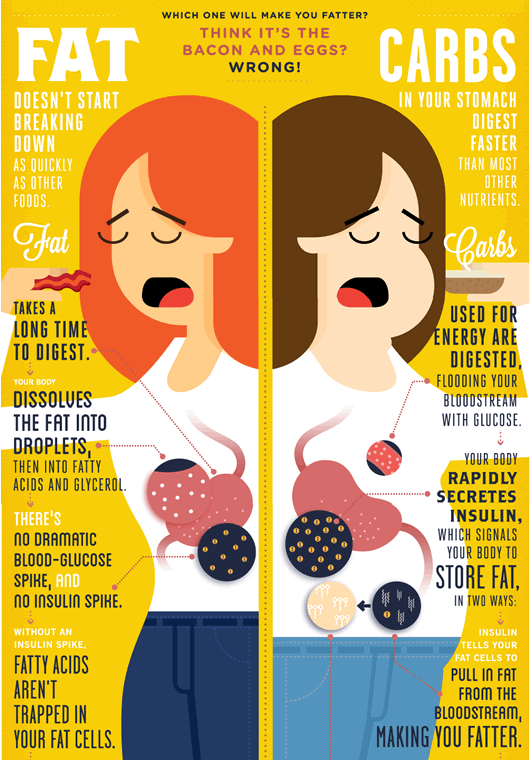
Think that bacon and eggs for breakfast will make you fatter than a bagel with low fat cream cheese? Think again; this chart explains what happens to fat and carbs inside your body:

You've heard that eating breakfast is important; this chart shows the difference in portion size for the rest of the day in breakfast eaters vs. breakfast skippers:

And I've had a theory that the reason any diet works in the beginning is because just about any diet is healthier that a no-holds-barred approach. Turns out the data agrees:

Other charts include:
- What effect your friends' eating habits have on your eating habits.
- What days of the week we tend to eat healthy -- or not.
- How eating at home compares to eating out.

In case you skipped the second paragraph, I'll say it again: There's more data than I'm showing here. Hit the original site if you're a data geek. Or infograph afficianado. Or you just want to improve your health.


Popular Posts